Performance Analysis
The time phased budget data is the foundation for completing the project's planned work effort. With an established the budget baseline, you can then routinely assess how well project teams have performed compared to the plan, typically every accounting calendar period. You measure work progress and import the actual costs incurred to do the planned work for each reporting period so you can proactively manage the remaining work effort, the estimate to complete, and make any course corrections for the remaining work.
Visibility into project performance helps you focus on areas that need additional attention. Calculating performance metrics at the total project level, selected level of the work breakdown structure (WBS), or work package level is useful for useful for identifying work elements where actual performance and costs incurred to do the work diverged from the plan. Common performance metrics include:
- Schedule Variance (SV) - either cumulative to date or for the current reporting period (in cost terms). This metric provides an indication whether you are completing more or less work than planned (earned value minus the budget). To complement the cost based metrics, the network schedule data is often used for other time based performance metrics such as the baseline execution index (BEI), current execution index (CEI), or total float consumption index (TFCI).
- Cost Variance (CV - either cumulative to date or for the current reporting period. This metric provides an indication whether your actual costs to do the work is more or less than planned (earned value minus the actual costs).
- Variance at Completion (VAC). This metric provides an indication whether the estimate at completion is likely to be more or less than the budget at completion (budget at completion minus the estimate at completion).
- Schedule Performance Index (SPI) - either cumulative to date or for the current reporting period (in cost terms).
- Cost Performance Index (CPI) - either cumulative to date or for the current reporting period.
- To Complete Performance Index (TCPI).
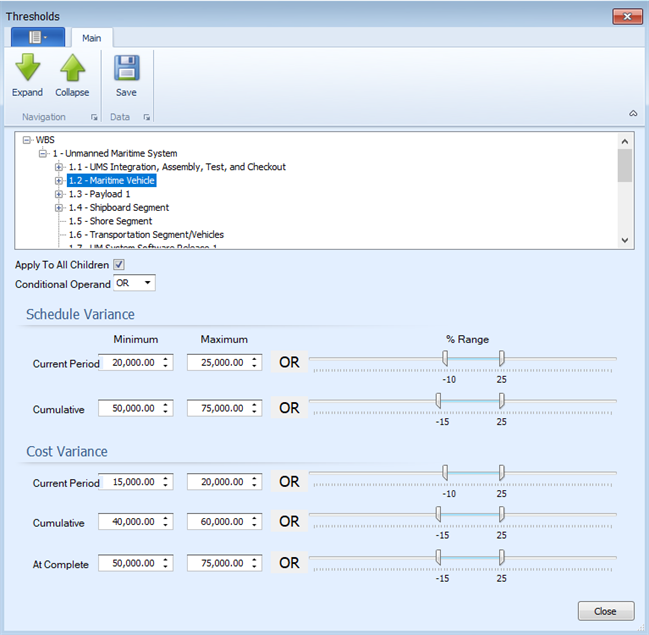
Variance thresholds are often used to define what is considered a significant schedule or cost variance that requires further analysis and potentially corrective action. Thresholds are useful for identifying work breakdown structure (WBS) elements that are about to exceed or have exceeded a threshold and producing variance analysis views or reports.
 What do you want to do?
- Set Variance Thresholds
- Validate Cost Values. This data view is useful for identifying common issues or data errors.
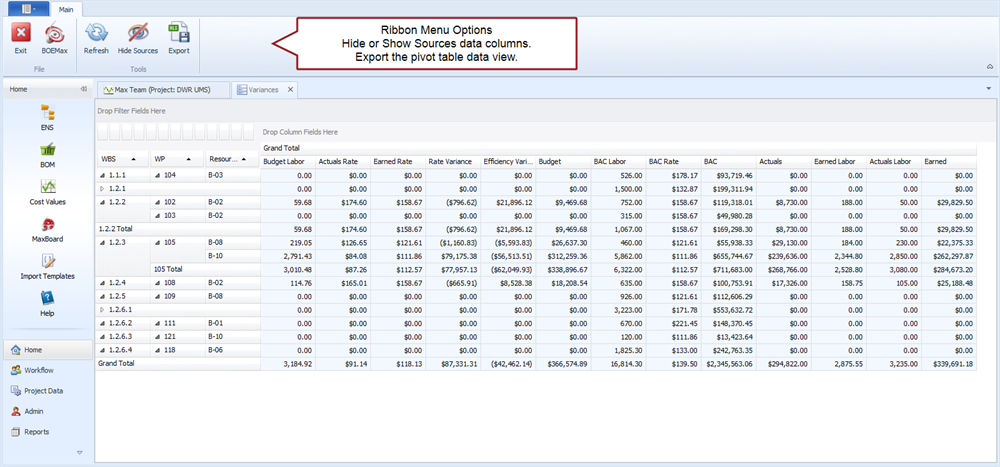
- Analyze Labor Variances
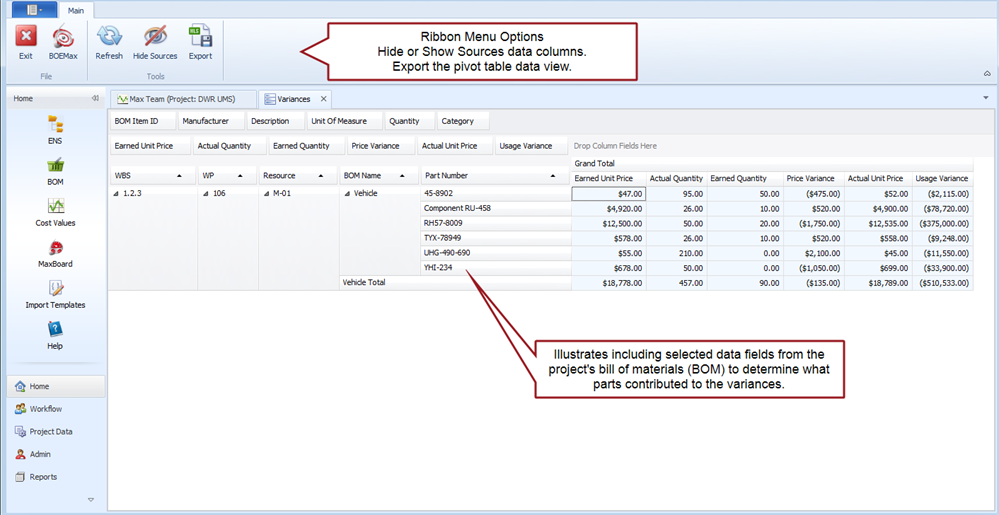
- Analyze Material Variances
- Analyze the CPI and SPI at any level of the WBS or work package level
Thresholds Window and Variance Tabs
Thresholds
Variances tab, Labor
Variances tab, Material